Bike Parking Systems in Poland: Racks, Lockers and Secure Facilities
The availability and quality of bicycle parking is a determining factor in how many people use cycling as a daily transport mode. Across Polish cities, provision ranges from basic galvanised racks bolted to a pavement to enclosed, CCTV-monitored facilities at main railway stations. This article describes the main categories of parking infrastructure currently deployed, where gaps remain, and what standards have been applied by municipalities and rail operators.
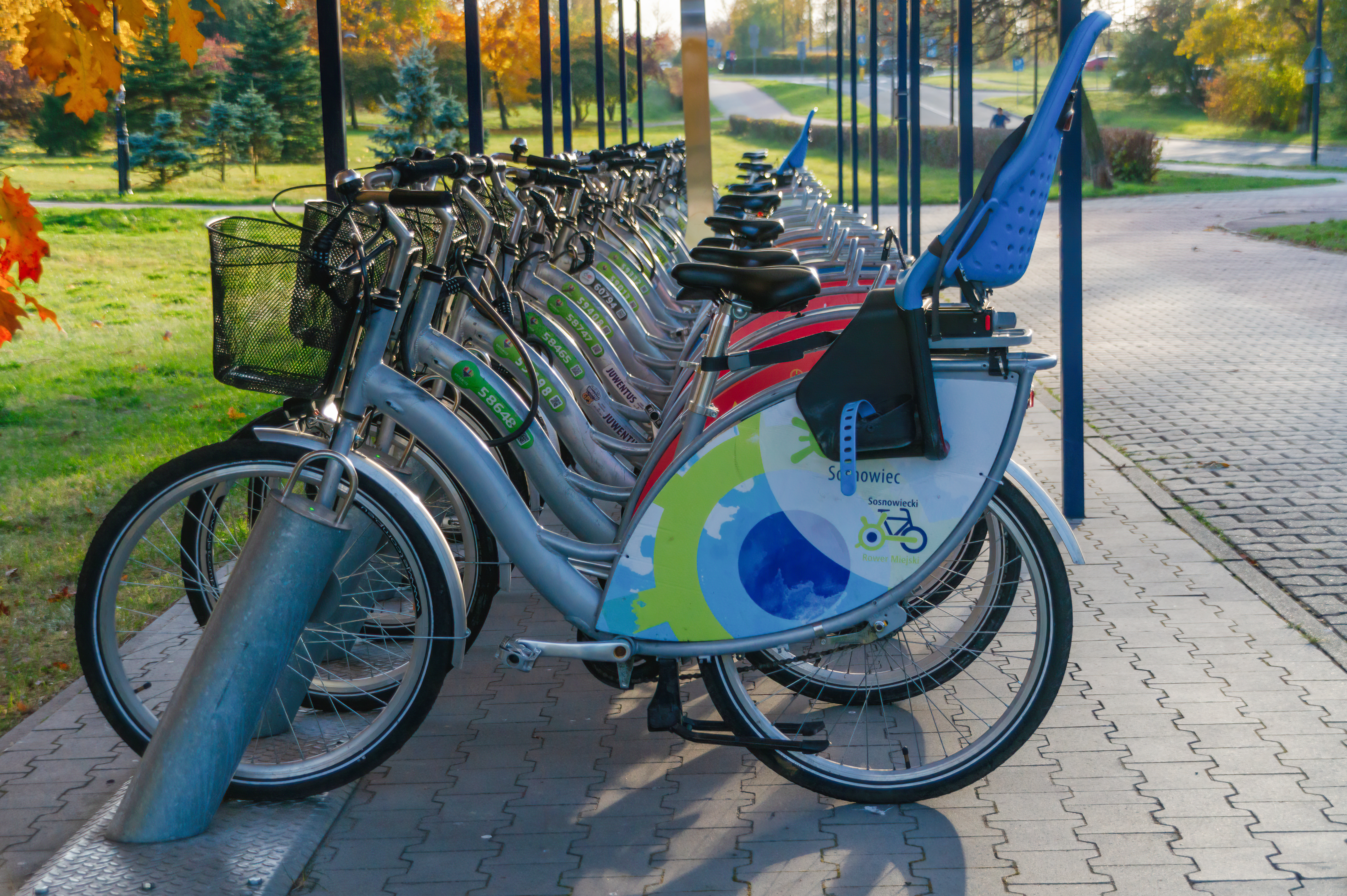
City bike station in the Śródula district of Sosnowiec. Sosnowiecki Rower Miejski operates docking stations combined with parking areas in several districts. Photo: Wikimedia Commons (CC BY-SA 4.0)
Street-Level Racks: The Baseline
The most common form of bicycle parking in Polish cities is the inverted-U rack (colloquially called a "shepherd's crook" or pałąk), which allows locking both the frame and wheel. Municipal guidelines in Warsaw, Kraków and Wrocław generally specify this type as the minimum standard for new installations. The racks are typically galvanised steel or stainless steel; spacing requirements vary, but most current guidelines specify a minimum 90 cm between rack centres.
Older installations in smaller towns and city peripheries include post-and-ring designs, which only allow locking the front wheel. These are considered substandard because they do not secure the frame and are associated with higher theft rates. Several municipalities have committed to phasing them out, though the timeline is not uniform across cities.
Covered Parking at Rail and Tram Stops
PKP (Polish State Railways) has introduced covered bicycle parking structures at a selection of larger suburban stations as part of its station modernisation programme. These structures, known as wiaty rowerowe, typically accommodate between 20 and 60 bicycles under a steel and polycarbonate roof. Access is open; there are no lockers or individual locks beyond what the user provides.
The effectiveness of wiaty rowerowe depends on location relative to station exits. Where shelters are placed near ticket halls and main exits, utilisation is generally high. Installations sited on secondary platforms or accessible only via level crossings tend to be underused. PKP publishes a list of stations with cycling facilities through its Station Search tool.
PKP Intercity bicycle rules
On long-distance PKP Intercity trains, bicycles require a dedicated bicycle spot reservation (miejsce rowerowe). The number of bicycle spaces per train varies by rolling stock type. Folded bicycles in a bag are transported as standard luggage without a separate reservation. Details are available at the PKP Intercity booking portal.
Enclosed and Secured Facilities
A small number of larger stations have installed enclosed bicycle rooms (przechowalnie rowerów) accessible by card or code. These provide weather protection and a degree of security monitoring. Warsaw Centralna station has a bicycle storage room operated by a third-party provider; access requires a paid subscription or daily fee. Similar facilities exist at Warsaw Gdańska and at Kraków Główny.
Bike lockers — individual metal boxes that fully enclose a single bicycle — are present at some Park and Ride (P+R) facilities on the outskirts of Warsaw and Kraków. These are generally co-located with car parks and targeted at commuters who combine cycling with rail or metro travel for the city-centre section of their journey.

Shared path for cyclists, pedestrians and skaters in Bielsko-Biała. Infrastructure quality in smaller Polish cities varies considerably from the main urban centres. Photo: Wikimedia Commons (CC BY-SA 4.0)
Residential and Commercial Parking
Polish building codes (as amended in 2021) require bicycle parking spaces in new residential, commercial and office developments above a certain floor-area threshold. The specific ratios differ by building type; for residential blocks, one bicycle space per dwelling unit is a common baseline. In practice, compliance varies: some newer developments provide enclosed basement bicycle rooms; others install racks in exposed courtyard areas with limited weather protection.
Large shopping centres and retail parks have increasingly installed bicycle racks near main entrances in recent years, partly in response to municipal cycling plans that link building permits to cycling infrastructure provision. The quality of these installations varies: some centres provide covered racks and repair stations; others provide only uncovered racks with insufficient capacity for peak weekend demand.
Bicycle Repair Stations
Self-service bicycle repair stations (stacje naprawy rowerów) have been installed in several Polish cities alongside existing cycling infrastructure. These stations typically include a mounted bicycle pump, a set of basic tools on cables (Allen keys, screwdrivers, a chain tool), and sometimes an instruction board. Warsaw has deployed repair stations at intervals along the Vistula riverside path and at major park entrances. Kraków has similar installations along the Planty ring park. The long-term reliability of these stations depends on maintenance contracts; tool theft and vandalism are reported issues at exposed locations.